Tuesday, February 7, 2012

Glimpses of Patan: the durbar square

I'm posting a few snaps from Patan Durbar Square - one of the most beautiful ensembles on the World Heritage Site list. There is a lot more to see and appreciate around the historic city of Patan but I'm going to start off with a personal favorite of mine - the Durbar Square. Of the three medieval palace complexes of the Kathmandu Valley, this square feels the liveliest. A combination of the beautiful architecture, art, sculpture and most importantly people and their every day lives make it a living square; a true public space that is open to one and all. On top of that, the cafe at the back in the palace garden is truly a delightful place to be. The Museum that can be entered through the Keshav Narayan Chowk (picture below) has a wonderful collection. 
Keshav Narayan Chowk - Patan Durbar now Patan Museum
Window on the main facade of the Patan Durbar  (Palace)
The central bay of the main window (Gaa Jhya)
Entrance to Museum
The palace complex and the adjacent square is located at the heart of the ancient city of Patan - one of the three major cities of the valley alongside Kathmandu and Bhaktapur, at the cross-roads of the two major city streets that run east west and north south respectively. The palace complex being parallel to the major road and its location is generally believed to be the geometric center of the historic town which was originally walled.  It is generally accepted that this city was yielded to the Lichhavis by the Kiratas during the 2nd Century AD even though the foundation is believed to date back only up to the 4th century AD. However, no palace building is believed to date back further than the 17th century when it took its present form to a large extent - during the reign of Siddhinarsingh Malla. The palace complex has four courts - Sundari Chowk, Mul Chowk, Taleju Court and Keshav Narayan Chowk

One of the most interesting aspects of traditional Malla palaces seems to be the volume of the buildings. Most of these buildings, temples are not dominant by size but rather by elaboration of details, materials used and through overall design. This is in contrast to most palace complexes found around the world that invariably tend to dominate the city-scape by their sheer size and monumentality. Another element that is common to both the Kathmandu and Patan Durbar is the presence of towers which is absent in the case of Bhaktapur. It suggests that perhaps tower were a later development which explains their absence at Bhaktapur. Also key to note that these weren't residential towers but religious instead. 

Another thing worth noting is how all the entrances to the temples on the square adjacent to the palace complex face the palace. This amazing public space is greatly colored by the stylistic variety of the temples found there that range from a simple tiered temple to shikhara styled temples, and other elements that define a traditional public sphere in the towns of the valley. Those elements are the oldest water spout Mani dhara, the twin sattals - Mani Mandapa, commemorative stone steeles and other sculptural jewels that occupy every nook and corner of this square. 

  
Mani dhara - oldest water spout in the valley
Krishna Mandir (Temple), Patan Durbar Square
View of Krishna Mandir from Mani Mandapa (Mani dhara)
One of my favorite Temple exteriors with lots of carvings
The Bell, Patan Durbar Square
View of Patan Durbar Square with the palace to the right undergoing restoration work
There is a lot to see around here and its not just limited to this wonderful slice of medieval paradise. There was a lot of restoration work underway when I visited the musuem and the square recently; starting from the   Mul chowk, the Sundari chowk that houses the famous Tusa Hiti, to the Bhandarkhal (gardens) at the back along with the water fountain that it contains. Of the temples in this square, the Krishna Temple at the northern most end, is perhaps the most famous of them all. It's the center of all worship during the Sri Krishna Janamasthami every year where hundreds of people come to pray. If you have time on your hands, do give this temple more than a fleeting glance. You'll see scenes from the Mahabharata engraved on the frieze above the columns on all sides of this temple. 

Updated Dec. 2016

Patan did not escape the April 2015 earthquake unscathed. The SW part of the palace complex suffered a lot of damage and as of July 2016 reconstruction work had commenced. A lot of temples in the main square outside the Palace were either damaged or fell. Krishna Temple has been shored up and awaits restrengthening. While the rest houses (patis) on either side of the dhungedhara collapsed.

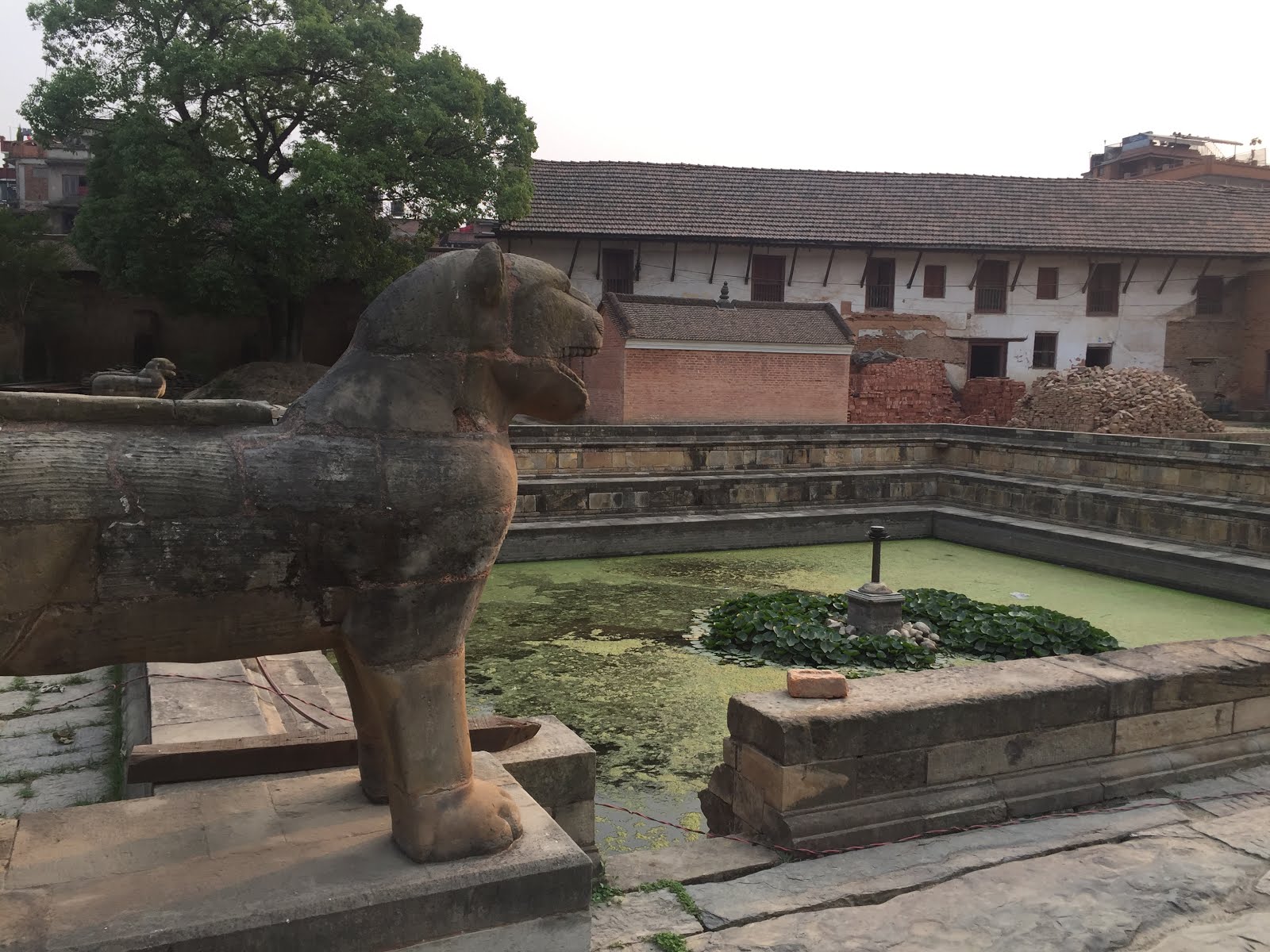
The recently renovated pond in Bhandarkhal with damaged building
in the back ground (July 2016)

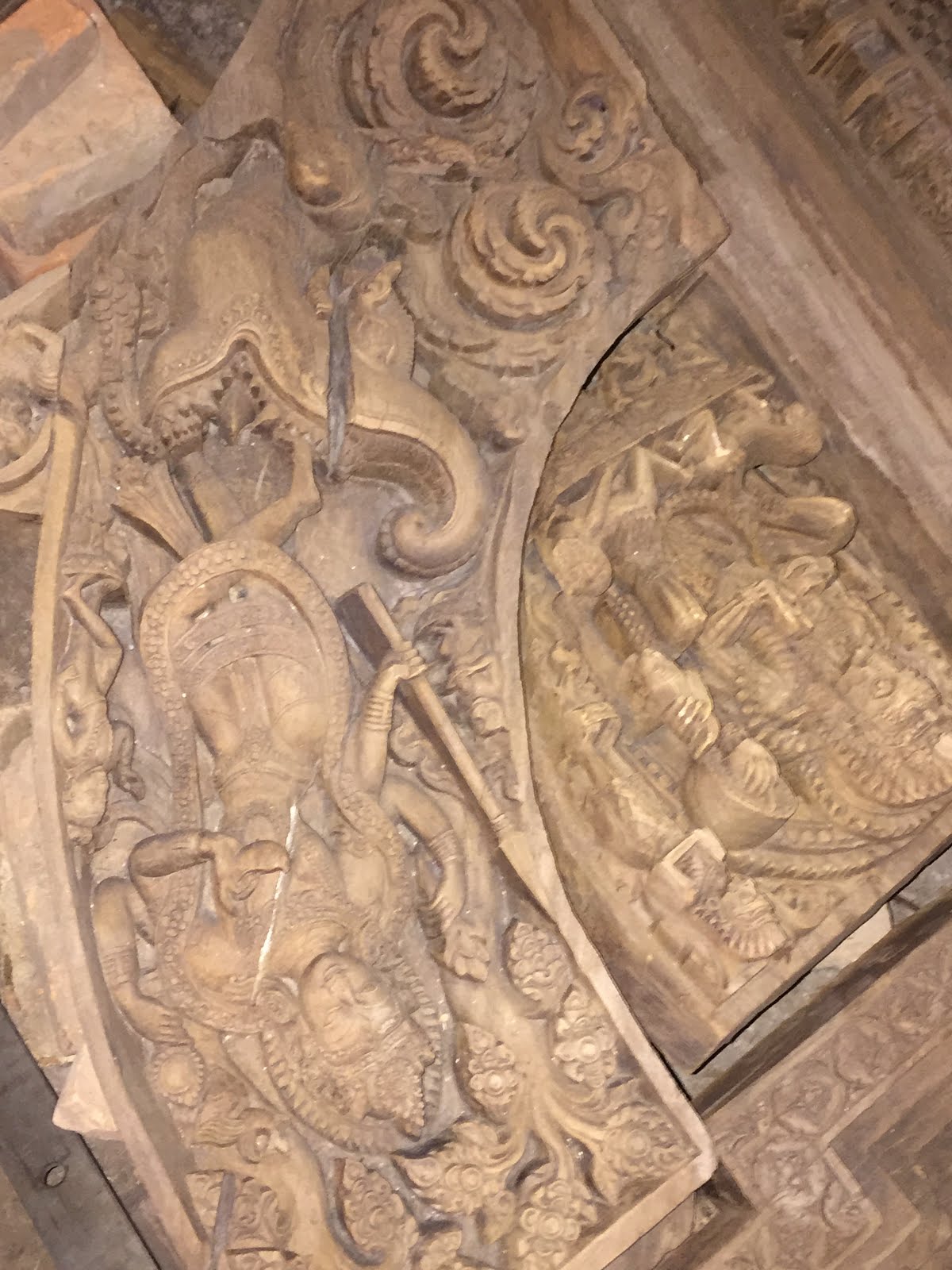
Pieces collected from debris (July 2016)

Temple Friezes collected and stacked for re-use (July 2016)

Carved wooden elements stored
(July 2016)
Building elements collected from fallen temples

Members awaiting repair works


Wooden members stored in temporary sheds at the back
which also works as workshops (July 2016)

View of the back court from top of museum wing (July 2016)

Dhungedhara to the North of palace (July 2016)

Damaged temples supported (July 2016)

Repair works underway (July 2016)

Parts of the chowks have been cordoned off
mainly for public safety (July 2016)

Wooden Struts / Tudals (July 2016)

Wooden Struts stored at the palace complex (July 2016)

Parts of Sundari Chowk have been damaged
(July 2016)

The beautiful Sundari Chowk (with Water spout)
(July 2016)

The Center piece of the complex (July 2016)

Mul Chowk reconstruction underway (July 2016)


Recently renovated pond at the gardens (Bhandarkhal)
July 2016


View from the back towards Mul Chowk
(July 2016)


Sunday, January 22, 2012

A stroll through Bhaktapur


My destination this week was the smallest of the three Kathmandu Valley towns, Bhaktapur, the city(pur) of devotees (Bhakta) – also called as Bhatgaon or BhadgaonKhoprinKhvapa or Khopah. It might be smallest but is certainly the best preserved and the oldest of the three cities. Traditionally, this town was amongst the main towns straddled on the trade route between Tibet and India. However, changes in political regime, construction of alternate motorable routes most notably – the opening of the trade route via Kalimpong by the British meant that the historical importance of those towns along the traditional route waned- one of those towns was Bhaktapur. Perhaps that was a good thing in hindsight because it may have helped preserve this unique place, its heritage and culture.


One of the best things about Bhaktapur is that there is little evidence of the ugly urban sprawl that characterizes the other two historical towns of Patan and Kathmandu. Unfortunately, sprawl is everywhere in the valley, so even though the core of Bhaktapur is reprieved of that ugliness, it is literally knocking at its doors because that's all you see before you get there - scattered glimpses of concrete randomness that has slowly replaced the surrounding agricultural lands. 


You must rewind back to the 70s to understand how change has occurred and also been deterred at the same time. The historicity of this wonderful place owes its preservation as well the continuity of certain traditional arts and craft practices to the Bhaktapur Development Project, a bi-lateral co-corporation between the Govt. of Nepal and the Govt. of the Federal Republic of Germany from 1974-1986. The project executed in three phases had a simple objective i.e., 'Improving the living conditions of the population of Bhaktapur' which it most certainly did.


Once the capital of the country from 12-14th century, Bhaktapur has been a UNESCO World Heritage Site since 1979.  You drive off the Arniko Highway towards the narrow streets and ultimately enter the city through one of the last remaining city gates, the uniqueness of this traditional urban-space becomes apparent. Once inside city limits, you travel through brick paved narrow lanes and brick faced buildings built following the traditional Newari architectural style almost crowd you on either side providing glimpses of what’s ahead at the heart of Nepali art and architecture.
The Nyatapola Temple, Taumadhi Tole, Bhaktapur
Driving through those narrow bricked paved streets - you have absolutely no clue what to expect, until it hits you - visually and aesthetically. The first glimpse of the five-tiered Nyatapola temple triggers your curiosity and by the time you get to the center of the square in front of the temple, you can be excused for getting overawed. And the best is yet to come! One of only two five tiered temples in Nepal, the Nyatapola was erected by Nepali King Bhupatindra Malla during a 5 month period from late 1701 into 1702. It enshrines Siddha Laxmi, the Hindu goddess of prosperity. Nyatapola is designed with five stepped plinths of progressively and proportionately reducing widths lined with pairs of guardians arranged in order of increasing power. They are wrestlers, elephants, lions, griffons and lastly two minor deities Simhini and VyanginiSpringing from a base square measuring 22.5 meters, the plinth which can be understood as a stepped pyramid rises to a height of 9 meters. From the plinth level, the main body of the temple rises to a further height of 22.5 meters to the top of its pinnacle. 


The square in front of the temple i.e., Taumadhi Tole, has an additional temple 'Kasi Bishwanath' dedicated to 'Bhairava' (circa 1717 AD)  which defines the eastern edge of the square and is an integral part of everyday life of the people of Bhaktapur since traditional festivals and jatras still take place here as a continuum of the age old traditions.


If you would like to stop for a quick bite or just a cup of coffee, there is a traditional rest-house which has been converted to a cafe at the south-west corner of this square. Another place for good coffee is the small outlet of Himalayan Jawa on the stretch of road between this square and the Tachapal Tole containing the famous Pujari Math
A stone temple with the 55 windowed palace at the back
East of the main Palace court
Square in front of the palace
Taumadhi Tole (square) in front of the Nyatapola Temple
Dattatreya Chowk (square) with the Dattatreya Temple at the back
The contrast between this square – which is more public in nature and the square in front of the Royal Palace is fairly evident. This square comes alive with people, the music and the noise- clatter of everyday that at times seems to compete with the massive temple itself. On the contrary, the square in front of the palace is quiet, calm and almost feels ordered where despite the unassuming nature – in terms of scale not architectural magnificence, the palace takes center stage and not the people.

National Art Gallery, Wood Carving Museum, Pujari Math - Bhaktapur
A typical stone paved alley
I really wanted to see the famous ‘Peacock window’ so the next stop was the Pujari Math which houses the National Art Gallery - Wood Carving Museum. Located about a five-ten minutes walk east of the Nyatapola temple, you arrive at another square - Tachapal Tole which is also littered with ancient monuments, a sunken water spout, rest-houses, commemorative stone pillars, the popular Dattatreya Temple and the famous Pujari Math. Since I did not have so much time, museum gazing had to be left for another day but I did find my way to the exquisite ‘Peacock window’. And if you need a bite, there is a Peacock Cafe overlooking the square, go figure!
Peacock Window, Pujari Math, Bhaktapur

The last part of this short tour was literally a mad-dash to the palace precinct and although I wanted to spend more time looking at the carvings, details and study some stone sculptures, look through the museum there - I didn't have much time. I did take some pictures of the 55 window palace, the square in front and the two stone temples, which is rather unique in Kathmandu. One of those stone temples built around the late seventeenth century is dedicated to 'Batsala Durga' but happens to be modeled on the Krsna Temple of Patan. 

The oldest surving section of this palace 'Mul Chowk' is believed to date back to 1342 AD. The palace itself has undergone a lot of changes and was one of the worst hit during the earthquake of 1934 AD. A lot of priceless art in the form of sculptures, murals, carved struts of historical value were lost not just due to the earthquake but also due to vandalism and the nature of reconstruction work following the earthquake. Some monuments have also been lost, the octagonal sattal was recently re-constructed using old photographs. 

I cannot close this post without the mention of the Golden Gate added during the reign of Ranjit Malla 1753/4 AD. The gilt metal, moldings and sculptures are beautiful. 
The Golden Gate, Bhaktapur Palace

Monday, January 16, 2012

Stupas of Kathmandu IV: Cha-bahil 'Dharmadeva' Stupa

Sketch showing the location of the major stupas of the Kathmandu Valley.
Cha-bahil stupa has been highlighted
The stupa plan, grey represents the Lichhavi votive chaityas
Believed to have been established by King Dharmadeva (father of King Mandeva - Lichhavi King) around the middle of the 5th century, this is also known as Dharmadeva stupa and also as Charumati Chaitya by some - the reference being to Charumati, the daughter of the Mauryan Emperor Asoka. Originally, this stupa is believed to have stood at the center of the courtyard of Manju Vihara(around 5th century). Although the vihara in its entirity no longer exists, the main shrine exists even today and can be found towards the south-west of the stupa. During the course of excavations and a series of renovations to the main stupa, several inscriptions dating to the Lichhavi period and a few important stone sculptures dating to the 6th-8th centuries have been recovered from this site. During renovation work carried out in February 16, 2003 – lots of antique statues, coins, small stupas, old bricks with inscription dating back to the Asokan period were found within the structure, which were again placed back in their original position after the reconstruction work was completed. It was widely reported that, the newly discovered brick (35.5 X 23 X 7 cm) was inscribed in Brahmi Lipi (script) similar to the inscription on the Asokan pillar at Lumbini. 

The stupa today stands alongside the stretch of ring-road connecting the busy traffic junctions of Gaushala to the south and Cha-bahil chowk to the north. Architecturally, the stupa rests on a one meter tall hemispherical drum (Hiranyagarbha); there is a hermica where eyes are painted on all four sides similar to other stupas in the valley. On the four opposite sides of the hemisphere, four aadibuddhas sit and the fifth one is represented by the eyes on the hermika. At the top, there are 13 steps (square unlike the circular rings of Swayambhu stupa) which are the 13 worlds of Buddhism to Nirvana. The present shape of the dome and the niches may have been designed in the 18th century, while its finial, with its thirteen tiers; the amalaka ring and the protruding central pillar may have assumed its shape during the 19th century. Comparatively, this stupa appears to be much simpler than Swayambhu. 

Tuesday, January 10, 2012

Stupas of Kathmandu III: Boudhanath

The third stupa in this series, the Boudhanath Stupa is located at the centre of Bouddha market area which is about five km. north east of Kathmandu and is also part of the ancient trade route to Tibet. Generally considered to be the biggest stupa in the country, it's also known as Khasti Chaittya, Khasau Chaittya and Khasa Chaitya. There are many legends most notably Tibetan that of a little girl Kang-ma as well as others that mention how the stupa was established by the Lichhavi king Mandeva Ist (464-505 AD). Since this is close to the Cha-bahil stupa which is dotted with Lichhavi votive chaityas, this claim cannot be ruled out entirely. 
Sketch showing the location of the major stupas of the Kathmandu Valley.
Boudhanath Stupa has been highlighted.

Bouddhanath Stupa - 2007
Picture by Tony Hagen - 1960
Boudhanath Stupa (Southern view) before 1960
An Aerial image of the Stupa and its surrounding area
(Date not known) Photo Credit to uploader, Source Google
Renovation - 1919/ 1920
The stupa was forgotten for a long time during the dark age in the history of Nepal like other monasteries lying around Cha-bahil-Sankhu link area.It was only after the visit of the Tibetan sage and bridge builder, Tong tang Gulepo in the late 14th – 15th century that the stupa then covered with weed came back to light.Guru Padma Sambav, tantric master from Drangso in Tibetan province of Tsang recognized as a Tulku-incarnation, excavated the big stupa around 15-16th century.Thus, the stupa became famous with Tibetans and they started making contributions to it. It was during the period of Sivasimha Malla (1587-1617) – Tibetans were appointed as the sextons of Bouddhanath in which time, a new finial was donated to the stupa. Reign of Pratap Malla, Rangrik Repa undertook work of restoration of stupaThus the actual architecture may date back to the Malla period or even pre-date it.The medieval architecture can still be seen in Daniel Wright’s sketches from his book ‘History of Nepal’ first published in 1877.  

Sketch by Daniel Wright
Stupa showing the twenty cornered plan
This development of Bouddhanath stupa that started in the Malla period with the appointment of a Tibetan resident seems to have continued in the Shah period too and there have been additions in 1818-1819, 1821, 1859 respectively. An image of the stupa in 1850-1860 can be observed from the sketches of H.A. Oldfield from his book – 'Sketches from Nipal'.

Only the recent images and sketches are mine. 
Sketch by H.A. Oldfield
Updated on December 2016

The Bouddhanath Stupa was damaged by the April 2015 earthquake. And as of November 2016 it was the first of the monuments to be successfully restored.

Bouddhanath Stupa damaged after the April 2015 earthquake
(Photo Credit @Robbyen)

Reconstruction work underway
(Photo Credit @Robbyen)

More pictures of reconstruction
(Photo Credit @Robbyen)

Photo taken on Oct. 2016 Credit @Robbyen

Construction of the Hermika
Photo taken on Oct. 2016 Credit @Robbyen

View of Stupa after reconstruction (Damaged in April 2015 earthquake)
Photo taken on Nov. 2016 Credit @Robbyen